



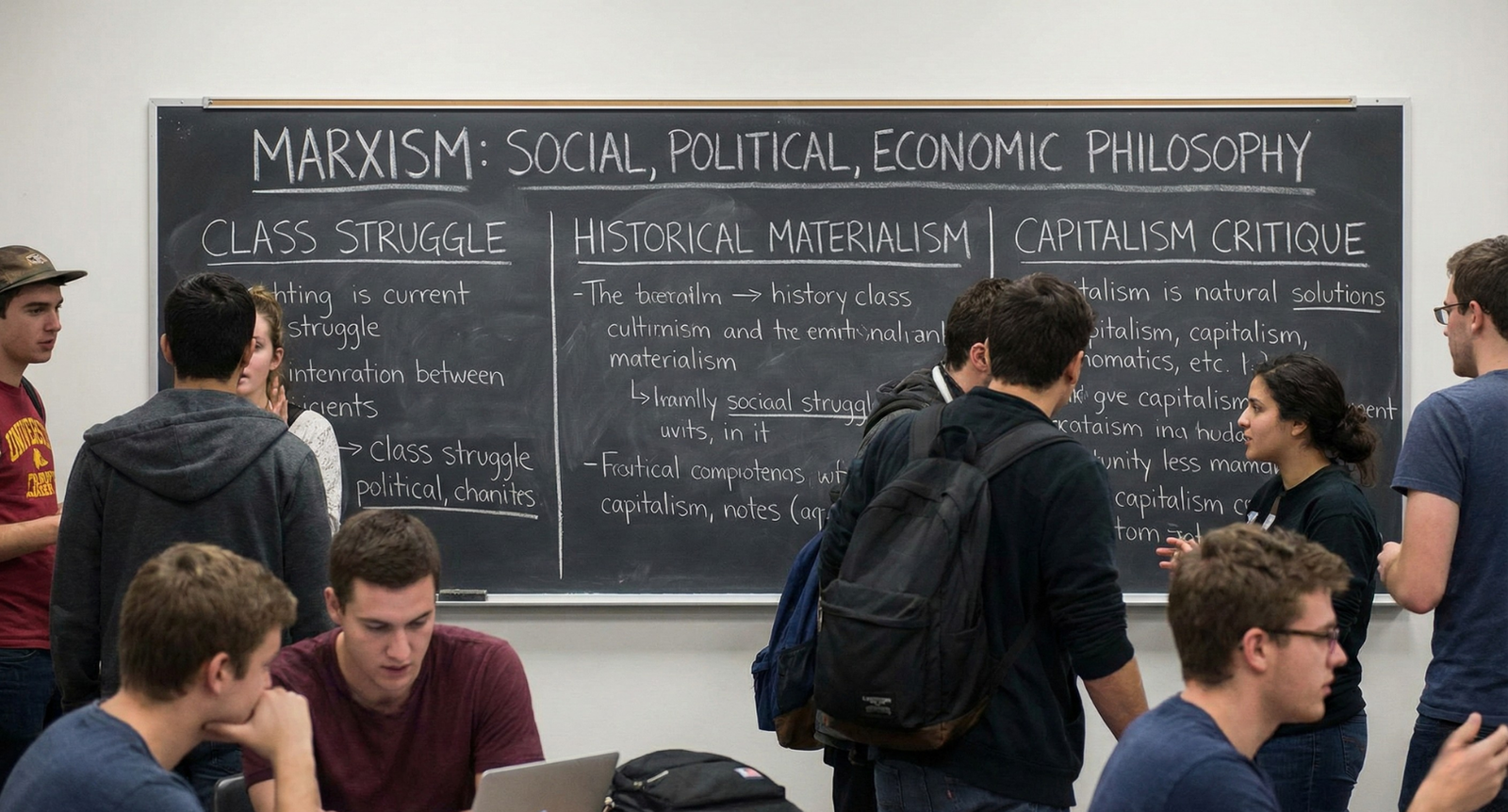
 Marxism is a social, economic and political philosophy that analyses the impact of the ruling class on the laborers, leading to uneven distribution of wealth and privileges in the Society. The theory was formulated by Karl Marx and his friend Friedrich Engels in their work, the Communist Manifesto (Political Pamphlet 1848). In this Pamphlet they discussed about the class struggle and criticised Capitalism.
Marx was writing during the industrial Revolution; a period of huge social change. Society was highly unequal. Most People worked in factories at very low wages and were very poor. They factory Owners were become wealthy and wealther.
Historical development of Class Struggle
There are five stages of class struggle;
(i) Primitive Communism:
Age of Hunter-gathering.
After the hunting the people were dividing the food equally in each other. There is no concept of rich and poor. They all are equal.
(ii) The age of Slavery:
The age of slavery is the base block of the concept of Class struggle. Class distinction between the aristocrats and the slaves.
(iii) Feudalism:
The Struggle was between landlords and the people who used their land for agriculture.
(iv) Capitalism:
Capitalism is called the main stage of class struggle in this stage there is two main groups, one is working class, it is called proletarian and the other is rulling class which is called bourgeoisies.
This stage is considered the worst stage.
(v) Socialism
In this stage the prolectarian would revolt for their justice. The demond if the prolecterian was to distribute the wealth equally among both prolecterian and bourgeoisie.
Key Concepts of Marxism
(i) Bourgeoisie Vs Proletarian
Bourgeoisie means upper/middle class and proletarian means lower class.
Bourgeoisie enjoyed the power to control the toiling masses, wages and work, leaving them vulnerable to even replacements in the future.
– The Bourgeoisie control the almost overall life of proletarian.
– There are only one percent Bourgeoisie in the society but they control majority resources.
there are 99% Proletation in the Society they worked for 1% bourgeoisie
The Bourgeoisie has control over education, religion and law.
(ii) Alienation
According to Marx, the organization of the capitalist system of production, which features a wealthy class of owners and managers who purchase labor from workers for wages, creates the alienation of the entire working class. Alienation means separation from society.
(iii) Base Structure vs Super Structure
The base structure is society. The tradition and norms are basically base structure. In the result of Base Structure, the super structure has been formed. Means ideas, thoughts etc. Base structure shapes and determine the content of the superstructure.
The way of thinking between Rich and Poor is different.
Base Structure can just think about Social institution
Education, law, and State.
Super Structure can controle the Social Consciousness
Religion, ideology, culture etc.
written by Muzamil Ahmad