



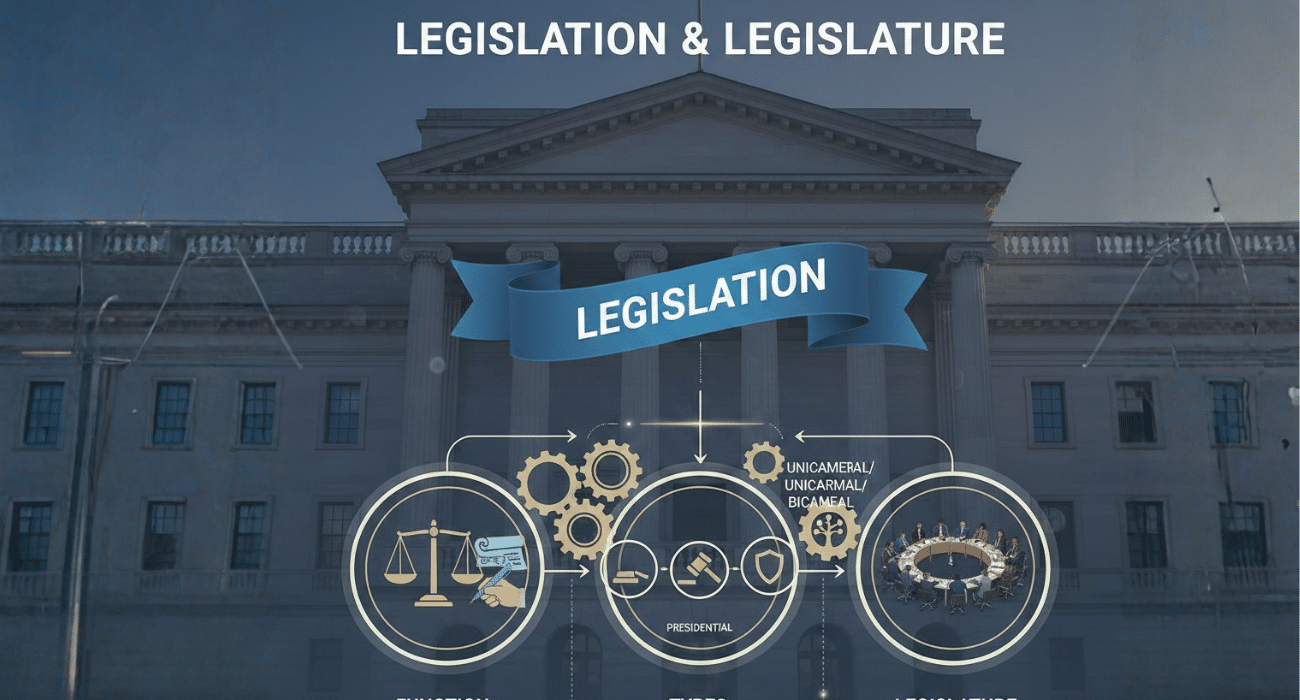
Legislation
the word legislation is the combination of two words;
Legis means law.
lates means To make.
legislation mean to promulgate the law or annoucement of law.
According to salmond ( critic ) legislation is a source of law which consist of the declaration of legal rules by a competent body.
Announcement of law or the making of law by a body who is impowerd by the constitution or fundamental law of the state
- function of legislature:
there are some other sort of function of the legislature
a) Financial function:
The financial function of the legislature includes:
– Approving the government’s budget and financial plans
– Authorizing taxation and expenditure
– Overseeing financial management and accountability
– Ensuring transparency in financial dealings.
Financial expension = income
it is called balance budget.
expense > income ( Deficient).
expense < income ( Surplus budget).
GDP: (Grass domestic product)
Each and every product produce within frontiers (boundries) of a state is the GDP of that country or state.
GNP: (Grass National products)
The product come from outside to the state or country is the GNP.
income divided by the whole population is called GDP per capita.
- Administrative Functions
1. Approval of Appointments
2. Oversight of the Executive Branch
3. Control Over Public Services
4. Formation of Committees
5. Supervising Public Institutions
Legislature can question public account community even chairmain of committees
- Judicial Function :
legislature is also responsible for judicial function, In Pakistan, the Parliament has certain judicial functions, such as impeaching the President or judges of the Supreme Court and High Courts. The legislature also has the power to make laws, which are then interpreted and enforced by the executive branch if the state.
If even the presendent have gentle issue or guilt of a misconduct then the legislature have the power to question the president for that misconducts.
Types of legislation
– There are different types of legislation
- Direct Legislation: When legislation proceeds from the supreme or subordinate legislature.
- Supreme Legislation: When a legislature proceeds directly from a sovereign (superior). Whenever a legislature proceeds from parliament it is an example of supreme legislature
- Subordinate Legislations
Whenever a legislation proceeds from any authority other than sovreign is called subordinate legislation.
Whenever the parliament issues broad guidelines and left the details for the department or authority or any body to work out for their day to day activities by means of delegated Legislation is called subordinate Legislation.
Indirect Legislation
The growth and development of law through the judicial interpretation is called indirect legislation
Executive:- Executive is the resposible for the implmentation of the will of the state that is implment of law etc for that purpose the central legislature (Supreme) issues broad guidelines and left the details for the executive to work out or formulate for a particular department or as the case may be
judicial Legislation:-
The rules framed by Judiciary for stream lining their day to day activities are called judicial Legislatue
Municipe Legislation:
The rules framed by municiple authority for a particular locality it is called munciple Legislature.
Autonomous Legislation
The rules framed by an autonomous body for their day to day activities is called Autonomous legislation. University acts are the example of Autonomous legislation
Colonial Legislation
The rules framed by ruling parties for their colonies to make law for their day to day activities is called colonial legislation.
e.g. In Indo-Pak subcontinent England has impowered the voice say to make law for their day to day activities in sub continent.
written by Muzamil Ahmad